
Nothing ruins a morning faster than a toaster that burns one slice and leaves the other pale. In the UK, where breakfast rituals range from quick rusks to leisurely weekend brekkies, choosing the right toaster matters more than it looks. This guide cuts through confusing specs and flashy claims to help you find a machine that browns evenly, lasts for years and suits your kitchen and budget. We'll test popular two-slice and four-slice models, compare toasting consistency, speed, build quality and easy-clean features, and explain which settings actually make a difference. Expect clear recommendations for tight budgets, style-led kitchens and large households, plus practical buying tips and a quick checklist to bring to the shop or save online. Read on and you’ll stop guessing and start enjoying reliably perfect toast every morning. We also cover energy efficiency, warranty considerations and the best toasters under different price points in the UK.
Best Toasters in UK
Dualit 2 Slice Lite Toaster

Peak and Pop is the standout here: you can lift the toast to check doneness without resetting the cycle, which makes getting bagels or thick bakery slices exactly right a breeze. The Dualit delivers even, consistent browning thanks to its ProHeat® elements, and the 1.44‑inch slots take big slices, sandwich bags or English muffins without pinching. Dedicated defrost and bagel buttons tailor heat where needed, and a slide‑out crumb tray makes cleanup quick.
Out of the box the stainless‑steel body mixes modern and retro charm, and the controls feel satisfyingly mechanical rather than gadgety—the lever, rotary dials and manual ejector are simple and dependable. Compared with cheaper toasters that underdeliver, this one actually gets used daily: sprung bread holders keep different thicknesses level, the peak‑and‑pop works smoothly (you must hold it up while peeking) and I’ve found repeatable settings for consistent results. Swappable side panels add a small customization bonus.
No appliance is perfect: Dualit’s premium badge comes with a premium price and it can feel surprisingly light when you first lift it. There’s no digital readout, and the learning curve to find your sweet spot takes a handful of breakfasts. If you prize build quality, long‑term reliability and exact toast control, Dualit is a strong choice; if you want the cheapest option or a fully digital interface, a simpler model will do.
Good pick for households that eat toast daily and value consistent results; not ideal for infrequent users or strict budget shoppers seeking extras.
Check price from AmazonSage - The Smart Toast - 4-Slice Toaster

Motorised lowering and the LED countdown make the Sage Smart Toast feel like a step up from ordinary toasters: press a button and the slices descend smoothly, the display tracks progress and a quick press pops the bread up for a look without resetting the cycle. That A Quick Look and the A Bit More feature really sell the idea of a hands‑off, repeatable result — useful if you share breakfast preferences or rescue a slice that’s just shy of perfect.
Performance is predictably consistent. The two independently controlled pairs of extra‑wide (≈4 cm) slots handle thick, rustic slices and crumpets without pinching, and the 2000W design browns evenly across slots. The crumpet/fruit‑loaf and frozen modes are handy, though the crumpet setting can overdo bagels if you like them soft in the middle. Unlike Dualit’s Peak and Pop manual lift, Sage’s motorised system enables the peek and top‑up tricks but adds mechanical complexity. Crumb trays at the front clean easily and the brushed‑metal finish feels robust; there’s a reassuring two‑year warranty.
There are trade‑offs. The slots are wide but not especially deep, so very long slices stick out; if you routinely toast sandwich‑length or oversized artisanal loaves you may prefer a longer‑slot model. The Smart Toast sits in the premium bracket at £159.99 — you can find cheaper toasters with similar basic features — but if you value the automated controls, consistent results and gadgetry that actually helps, it’s a satisfying, well‑built appliance that earns its place on a busy counter.
Check price from AmazonRussell Hobbs Inspire 4 Slice Toaster

Sleek and solid, the Russell Hobbs Inspire Four Slice Toaster dresses up a counter without costing a lot. Its white rippled casing, chrome trim and blue LED indicators give it a more premium look than many budget machines, and the lift‑and‑look and high‑lift features let you check and remove toast safely. You get frozen, cancel and reheat buttons too, and separate levers for each pair of slots save energy when you’re only making one round.
Performance surprised me: it toasted evenly across thicker and standard slices better than most budget rivals, matching or beating results I’ve seen from cheaper models and coming closer to the consistent browning of pricier options. It isn’t as fast as the Sage Smart Toast or the Dualit’s ProHeat® element — cycles ran over two and a half minutes — but it prioritises a crisp, golden finish over speed. The reheat and defrost work well and the removable crumb trays and cable tuck make it tidy to use. Given its price, the balance of style and reliable results feels like a solid everyday trade‑off for most kitchens.
There are trade‑offs. It lacks bagel and warming modes and only has one browning dial, so you can’t fine‑tune each side. Very tall slices leave the top inch underdone and the plastic body can run warm. For buyers who want premium conveniences like Peak and Pop or automated top‑up, the Dualit or Sage remain better choices. If you want stylish, reliable four‑slice results at a budget price, the Inspire is hard to beat.
Check price from AmazonBreville Curve 4 Slice Toaster [VTT786]

A showpiece on the counter, the Breville Curve draws the eye with a glossy curved texture, chrome trim and illuminated controls that make settings easy to read. Its variable-width slots and a 1–9 browning dial give you flexibility for thick slices, crumpets or bagels, and the Lift & Look plus High Lift make mid‑cycle checks and small-item removal foolproof. It feels light and neatly finished — a clear step up visually from the plainer Russell Hobbs Inspire but without the price tag or polish of a Dualit.
Performance is mostly solid: defrost, reheat and cancel work as you’d expect, the removable crumb tray slides out cleanly, and non‑slip feet and cord storage keep the footprint tidy. That said, the Curve has trade‑offs. At the same dial setting a single slice comes out noticeably darker than two slices, and the left slots only activate when the right slots are on — an inconvenient quirk if one pair fails. The power cable is short, so plan placement near an outlet. Toasting is fast, but not as predictably even as the Dualit or the Sage Smart Toast, both of which manage more consistent browning and automated controls respectively.
If looks and mid‑range functionality matter most, the Breville Curve is a compelling choice: it’s more stylish and feature‑rich than the Russell Hobbs, cheaper and less automated than the Sage, and less relentlessly even than the Dualit. Buy it for design, convenience and decent versatility; skip it if you need perfectly matched browning on every cycle or a long power lead.
Check price from AmazonSalter Pebble 4 Slice Toaster

Style-first and wallet-friendly, the Salter Pebble 4‑Slice toaster dresses your worktop without demanding a premium. It’s part of a coordinated kitchen range, so pairing it with the matching kettle and canisters gives a neat, curated look. The unit feels lighter than its footprint suggests, which makes it easy to tuck away; straight from the box you should run an empty high cycle to burn off the initial plastic smell. Controls are simple and solid—dials, levers and buttons operate smoothly and feel durable.
Functionally it does the basics very well. Six browning levels and self‑centring wide slots handled thicker slices, bagels and crumpets without pinching, and the two‑slot control layout suits households with differing preferences on either side. Toast at levels three to four produced an even colour, and the frozen and keep‑warm settings performed reliably. High‑lift eject, dual rear crumb trays and a cool‑touch exterior make daily use and cleaning straightforward, and anti‑jam protection adds peace of mind.
If you crave specialist tweaks you’ll notice gaps: there’s no dedicated bagel mode or a peek‑and‑top‑up feature. Unlike the Dualit with Peak and Pop or the Sage Smart Toast with automated cycles, the Salter sticks to straightforward manual operation. Compared with the Breville Curve, it toasts more consistently, and it offers a similar coordinated style to the Russell Hobbs at a very competitive price. For families who want a stylish, efficient four‑slice toaster without premium frills, this is a sensible, attractive choice. It’s a pragmatic pick for everyday kitchens wanting to look good.
Check price from AmazonMagimix Vision See Through 2 Slice Glass Toaster
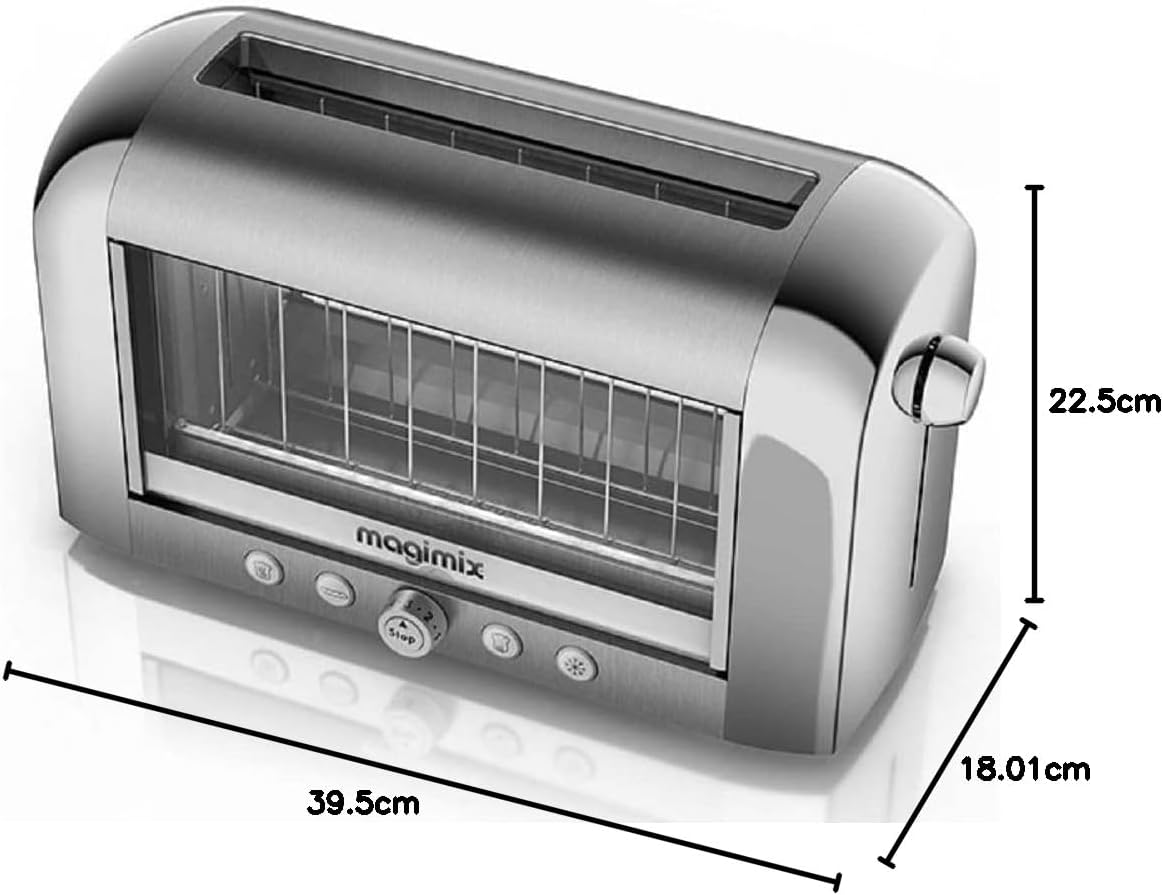
The see‑through sides are the Magimix Vision’s headline trick: you actually watch bread brown, which makes hitting an exact shade delightfully easy. The stainless steel and glass build feels heavy and substantial, so this is a worktop resident rather than a cupboard toaster. One long slot swallows two large slices, an artisan slab or a halved baguette, and eight browning levels plus a Stop button give precise control. The high lift makes retrieving small pieces safe, and overall colouring was pleasingly even in my runs.
Functionally it covers the bases you’d want: a baguette mode to toast one side, a 30‑second reheat and a frozen setting that reliably rescues slices straight from the freezer. We did see a tendency for sourdough and bagel edges to darken more quickly, but dialing the level back usually fixed that. Cleaning is simple — removable crumb tray and a clever underside lever that opens the double‑layer glass for easy wiping — which offsets the downside of the “see everything” aesthetic that will put crumbs on display.
This sits firmly at the premium end: it’s pricier than the Salter Pebble and lacks some automation of the Sage Smart Toast, but unlike the Dualit it gives visual feedback rather than a pop‑up ritual. It feels more consistent than some Breville Curves we’ve tried. If you prize build quality, visual control and longevity and don’t need four slices or the cheapest buy, the Magimix is a strong, stylish choice. If you want budget value or fully automated presets, look elsewhere.
Check price from AmazonBosch MyMoment Delight TAT2M123GB - Compact 2-Slice Toaster

The Bosch MyMoment Delight makes a compact style statement: matte finish, glossy black accents and a pop of red, plus a built‑in stainless steel warming rack that pops up for croissants and rolls. It keeps counters tidy with integrated cable storage, rubber feet for stability and a front crumb tray that slides out for easy cleaning. Controls are basic and logical — a single browning dial and defrost function — so it’s easy to use straight away.
Performance is solid for a two‑slice machine. Toast comes out evenly on both sides and the dial gives fine control for anything from thin supermarket slices to denser wholemeal. The warming rack is genuinely useful and tucks away when you don’t need it, which feels smarter than lugging a separate accessory around. Unlike the Dualit with Peak and Pop or the automated Sage Smart Toast, Bosch stays manual but dependable. It doesn’t offer the visual flair of the Magimix Vision glass toaster, nor the four‑slice capacity of the Salter Pebble, but it sits comfortably between those options as a practical, mid‑range choice.
The main trade‑off is slot size: thicker artisan slices or big bakery buns can be a squeeze. If you need oversized slots, four slices or fussy automations, look higher up the range. For a small kitchen where compact footprint, even toasting and a built‑in pastry warmer matter, the MyMoment Delight delivers sensible value without fuss. Price sits comfortably in the mid‑range for what you get overall.
Check price from AmazonRussell Hobbs 2 Slice Luna Toaster

Fast and flashy, the Russell Hobbs Luna aims to speed up mornings with fast toasting technology that claims roughly 50% quicker cycles than older Russell Hobbs models. The stainless‑steel, high‑shine shell looks pricier than it is, and the extra‑wide slots swallow thick hand‑cut slices, cobs or bloomers without pinching. Variable browning plus lift‑and‑look means you can check progress without cancelling—handy if you like to nudge toast toward a particular golden.
Performance feels reliable: cancel, reheat and defrost buttons respond crisply and high‑lift makes retrieving small pieces safe. I found it browns evenly at mid settings and, as other owners note, doesn’t scorch easily unless you push the dial to the top. Removable crumb tray and cord storage keep maintenance tidy. It’s not as obsessively precise as a Dualit or as automated as Sage’s Smart Toast, but it’s noticeably faster than basic two‑slice models like the Bosch MyMoment Delight.
For the price this sits squarely in mid‑range value territory—more stylish and capable than budget toasters, without the premium engineering or longevity claims of Dualit or Magimix. If you need quick, consistent toast for a mix of homemade and shop‑bought loaves, Luna delivers. If you want the absolute best long‑term durability or feature‑packed automation, consider stretching to a Dualit or Sage; otherwise Luna is a practical, attractive choice. It won’t match the see‑through precision of the Magimix Vision for visual control, but for kitchens Luna’s mix of speed, looks and everyday convenience will suit couples or small families and light‑use households.
Check price from AmazonSmeg TSF03PBUK 4 Slice Toaster

Bold retro styling and four wide slots make the Smeg TSF03PBUK a statement piece for busy kitchens. It’s large and weighty, built from quality materials and offered in several colours to suit a bold scheme. Two independent controls let you run different settings at once, with six browning levels plus defrost, reheat and a baguette function that heats one side only. In use it browned slices, bagels and crumpets evenly and the buttons stop and eject quickly.
Practical details are mixed: twin removable crumb trays and a cable tidy make cleaning and storage straightforward, but the toaster is bulky and will likely live on the counter. I missed a high‑lift to ease removal of smaller pieces — once the lever pops up there’s no extra height — and when toasting frozen slices the top sometimes sits above the elements and only defrosts rather than crisps. It also lacks simple markings to show which way to face bagels or crumpets, so you may end up watching the elements or swapping halves to get the right side toasted.
At this price the TSF03PBUK sits in the premium bracket, favouring looks and four-slice capacity over small conveniences. Unlike the Dualit with Peak-and-Pop or Sage’s Smart Toast, it doesn’t offer automated peek or top‑up, but it handles family loads better than compact two-slice toasters such as the Bosch MyMoment and has more presence than a Russell Hobbs. Buy if space, style and batch performance matter. It’s worthy, if pricey, as a countertop centrepiece.
Check price from AmazonMorphy Richards Equip 2 Slice Toaster

Good value and sensible features are what make the Morphy Richards Equip 2 Slice Toaster worth a look: wide, variable slots take everything from thin sliced bread to crumpets and tea cakes, and you get defrost, reheat and variable browning control without paying a premium. Unlike the Dualit or Sage models, it doesn’t have a peek‑and‑pop or automated top‑up, but it does cover the basics well for everyday use and undercuts the Smeg on price and bulk.
In practice it toasts evenly for most slices and the range of settings gives good control over colour. The removable crumb tray and tidy cord storage keep a small kitchen neat, and the metal finish looks smarter than a basic plastic kettle‑coloured alternative. The drop‑down lever replaces an auto‑lift button some buyers miss, but it feels sturdy and responsive rather than flimsy.
Not everything is perfect: a minority of users report uneven results or that a slice didn’t toast on both faces, so if you demand absolute, repeatable perfection every cycle you might prefer the more consistent automated appliances such as the Sage Smart Toast or the premium Dualit. For most people, though, those are premium trade‑offs you pay extra for.
If you want a compact, no‑nonsense two‑slice toaster that looks good on a shelf and handles different bread sizes, the Equip is a sensible, budget‑friendly choice. Choose it if you prioritise value and simple reliability; step up to a Sage or Dualit if you need bells, whistles and the last word in consistency.
Check price from AmazonBreville Zen 4 Slice Toaster
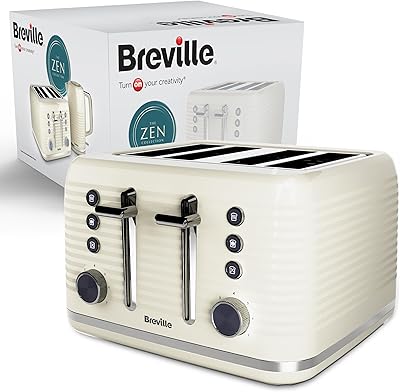
The Breville Zen 4‑Slice stands out for its gloss linear design and a useful Lift & Look window that lets you check progress without resetting the cycle. It pairs chrome accents and illuminated controls with practical touches like variable‑width slots, so you can handle anything from thin supermarket slices to thick artisan bread, and the High Lift makes small items easy to fish out.
Performance is straightforward and mostly reliable: independent dual browning controls let two people toast to different shades at once, and the defrost, reheat and cancel buttons cover the usual bases. Toasting is generally even and quick; the removable crumb tray, cord storage and non‑slip base keep it tidy. Compared with the premium Dualit (which delivers extremely even browning and the Peak & Pop convenience), the Breville feels less specialist but much more affordable. It’s simpler than the automated Sage Smart Toast and less bulky than the Smeg 4‑slice, while offering more capacity than the two‑slice Russell Hobbs.
That said, buyer reports are mixed on durability and edge‑to‑edge consistency: some owners praise the even results, while others have seen uneven browning or early failures after a few weeks. Frame those as trade‑offs — if you want a stylish, feature‑rich home toaster at good value, the Breville is a sensible pick. If you need rock‑solid long‑term reliability or absolute precision on every slot, consider stepping up to a Dualit or Sage.
Check price from AmazonKenwood Dawn Toaster
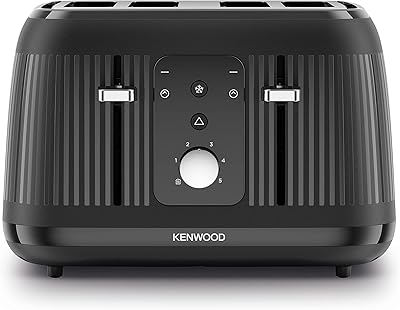
A sensible all‑rounder for families: the Kenwood Dawn gives you four slots, independent halves and rapid 1800W heating so you can run a quick two‑slice cycle without firing the whole unit. It’s reasonably priced and looks smart on the counter, with a cool‑touch exterior and illuminated buttons that make morning routines less fiddly.
Toast performance sits where you’d expect for the money. Five browning settings and a high‑rise lift let you dial in thickness and retrieve smaller items safely, while electronic controls add reheat, defrost and a one‑sided bagel mode for variety. The wide slots handled crumpets, thicker slices and bagels without pinching, and the pull‑out crumb trays plus cord storage keep cleanup and tidiness straightforward.
Compared with the premium Dualit you won’t get Peak‑and‑Pop or hotel‑grade metal construction, and the Dawn lacks the automated top‑up cleverness of the Sage Smart Toast. It does, however, beat many two‑slice machines like the Russell Hobbs Luna on capacity, and it’s less bulky and showy than a Smeg while still complementing a kitchen visually.
Trade‑offs are clear: if you want long‑term, heirloom build or the last word in browning control, look higher up. If you want a practical, family‑friendly toaster that toasts evenly, handles frozen bread and cleans up easily, the Kenwood Dawn is a solid, value‑focused pick.
Check price from AmazonTower T20051MNB Cavaletto 4-Slice Toaster

Four slots and six browning settings give the Tower Cavaletto immediate appeal: it’s a practical, room‑friendly toaster that aims to cover basics—defrost, reheat and cancel functions let you handle frozen slices or warm-ups without fuss, and the removable crumb tray plus cord storage keep counters tidy. The anti‑slip feet feel thoughtful for everyday use and the variable dial gives more control than the simplest two‑setting models.
Performance sits somewhere in the middle. Some owners report nicely browned, consistent results, but others see uneven toasting or hardware hiccups after a few months. That inconsistency puts it behind the Dualit and Sage Smart Toast on reliability and precision—Dualit still wins for even browning and Sage for automated consistency—while it’s broadly comparable to the Russell Hobbs Luna on everyday usability. It won’t match the Smeg’s salon‑style presence, but it’s less bulky and more kitchen‑practical.
Build and finish divide opinion: several buyers praise the look and feel, others dislike the colour or question long‑term value. That split frames the trade‑off: you get a useful four‑slice machine with sensible features at a midrange price, but you’re trading some durability and toast uniformity compared with premium models. If you want a budget‑friendly four‑slice toaster that does the job for family breakfasts, the Cavaletto is a reasonable pick; if you prioritise consistently even browning and long-term reliability, stepping up to a Dualit or Sage will repay the extra cost.
Check price from AmazonBreville Bold 2 Slice Toaster [VTR003]

The Breville Bold 2‑Slice makes its case with smart, user‑friendly features: Lift & Look plus a high‑lift lever let you check or retrieve smaller items without restarting or burning your fingers, and illuminated controls with a glossy, ridged finish give it a more premium feel than its price suggests. Two variable‑width slots handle thick or thin slices, seven browning settings let you dial in colour, and handy extras—defrost, reheat, cancel, removable crumb tray, non‑slip base and cord storage—cover the everyday bases.
In use it mostly performs well. On a mid setting (about 3 of 7) it browned a standard sandwich loaf evenly and the slots accept longer slices sideways, while the crumb tray pops out cleanly. That said, buyer reports are mixed: some users praise the value and ease of use, others find the casing a little tinny and have early failures. Compared with Dualit’s Peak and Pop and rock‑solid build, Breville doesn’t aim for heirloom durability; and while it borrows the practical peek/top‑up idea that Sage automates in its Smart Toast, it’s a simpler, manual package. It’s closer in spirit to the Russell Hobbs two‑slicers—compact and functional—rather than the bulky, design‑forward Smeg four‑slice.
If you want a compact, feature‑practical toaster that hits most marks at a reasonable price, this is a sensible pick. If flawless long‑term reliability or ultra‑even, premium browning matters most, consider stepping up to a Dualit or Sage instead.
Check price from AmazonAmazon Basics Toaster

Value-for-money versatility is the headline with the Amazon Basics 2-slice toaster. Its extra-wide slots (about 14 x 3.8 cm) swallow thick slices and bagels without pinching, and the compact footprint saves counter space and energy—handy if you don’t need a bulky four-slice machine like the Smeg and don’t want to spend for a Sage or Dualit. The removable rack for warming or gently defrosting pastries and the clear LED one‑touch buttons (defrost, reheat, cancel) make everyday use straightforward, especially for anyone who wants simple, predictable controls.
Toast control is solid for the price: seven shade settings let you nudge results from light to well done, and the back-mounted removable crumb tray keeps cleanup quick. That said, results aren’t as consistently even as pricier models—some users report patchy browning—so if you prize near‑perfect repeatability (or the Peak and Pop convenience of a Dualit or automated consistency of the Sage), you’ll notice the difference. On the flip side, people with limited hand strength like that extra-simple interface and single‑button operations.
Build quality earns mixed marks. Many buyers find it sturdy and reliable for daily use, but a minority report failures within a few months; consider this a trade‑off of budget pricing versus long‑term durability. If you want a cheap, compact toaster that handles bagels, frozen pastries and basic needs well, this one’s a sensible pick. If you want premium finish, ultra‑even browning or a larger capacity, look to Dualit, Sage or Smeg instead.
Check price from AmazonSwan ST19034BLK Wave 2-Slice Toaster

Smart looks and sensible features make the Swan ST19034BLK Wave a strong budget choice for small kitchens. Its two variable-width, self-centering slots handle everyday bread, bagels and crumpets without faff, and the seven browning levels give you real control — one user keeps theirs at 6 for consistent results, and I found the settings repeatable enough that you rarely have to run a second cycle. The matching Swan Wave kettle styling is a nice countertop pairing if aesthetics matter.
Performance is straightforward and dependable. The defrost, reheat and cancel buttons work as expected and save you fiddling when mornings are rushed, and toast comes out evenly across a range of sliced bread. Unlike premium options such as the Dualit with its Peak and Pop or Sage’s Smart Toast automation, the Swan keeps things simple: no fancy sensors, but a reliable output at a much lower price. Compared with the Russell Hobbs Luna it’s similarly quick but offers finer browning control; it won’t match the Smeg’s four-slice capacity or high-design heft, but it’s far less bulky.
The build feels sturdy, doesn’t slide when you push the lever, and cleaning is easy thanks to a removable crumb tray and tuck-away cord. A few customers find the overall footprint a bit small and very thick artisan slices may be a tight fit despite the adjustable slots — that’s the main trade-off.
If you want a compact, good-value two-slice toaster that looks smart and performs consistently, the Swan Wave is an excellent pick. If you need premium features, ultra-precise browning or a 4-slice machine, consider stepping up to Dualit, Sage or Smeg.
Check price from Amazon
Comments
Post a Comment